Last updated: June 2026
By CalcOrigin Editorial Team
What Is Mass?
Mass is typically defined as the amount of matter within an object. It is most commonly measured as inertial mass, involving an object's resistance to acceleration given some net force. Matter, however, is somewhat loosely defined in science, and cannot be precisely measured. In classical physics, matter is any substance that has mass and volume. A mass calculator helps you determine the mass of an object when you know its density and volume, eliminating manual calculation errors and saving time. This is particularly useful when working with materials that have well-known densities, such as metals, liquids, and common construction materials.
The amount of mass that an object has is often correlated with its size, but objects with larger volumes do not always have more mass. An inflated balloon, for example, would have significantly less mass than a golf ball made of silver. This is because density plays a crucial role in determining how much mass is packed into a given volume. Our mass calculator takes both density and volume into account, giving you accurate mass values regardless of the material. The relationship between mass, density, and volume is expressed by the formula m = ρ × V, which is the fundamental equation used by the calculator.
Mass is one of the seven SI base quantities and is measured in kilograms, the only SI base unit still defined by a physical constant rather than a physical artifact. The kilogram was redefined in 2019 using the Planck constant, ensuring its stability and universality. This redefinition was a milestone in metrology, the science of measurement, and reflects the importance of accurate mass determination in modern science and industry. Understanding the concept of mass and being able to calculate it accurately is essential for anyone working in scientific, technical, or engineering fields.
Types of Mass
There exist other common definitions of mass including active gravitational mass and passive gravitational mass. Active gravitational mass is the measure of how much gravitational force an object exerts, while passive gravitational mass is the measure of the gravitational force exerted on an object within a known gravitational field. In general relativity, these two concepts are equivalent, a principle known as the equivalence principle, which was famously tested by Galileo and later refined by Einstein.
Inertial mass, on the other hand, measures an object's resistance to changes in motion. When you push a heavy object, you feel its inertial mass resisting acceleration. The more inertial mass an object has, the more force is required to change its velocity. This is why a fully loaded truck takes longer to stop than a small car traveling at the same speed. Understanding these different aspects of mass helps in fields ranging from basic physics to advanced engineering design.
Mass vs Weight: Understanding the Difference
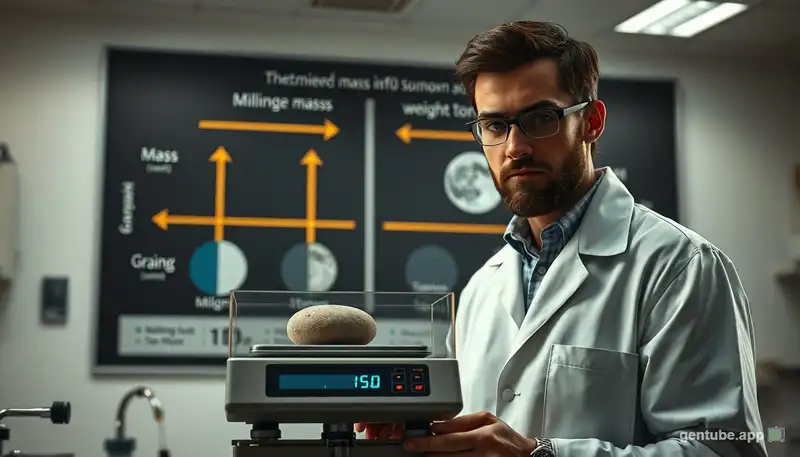
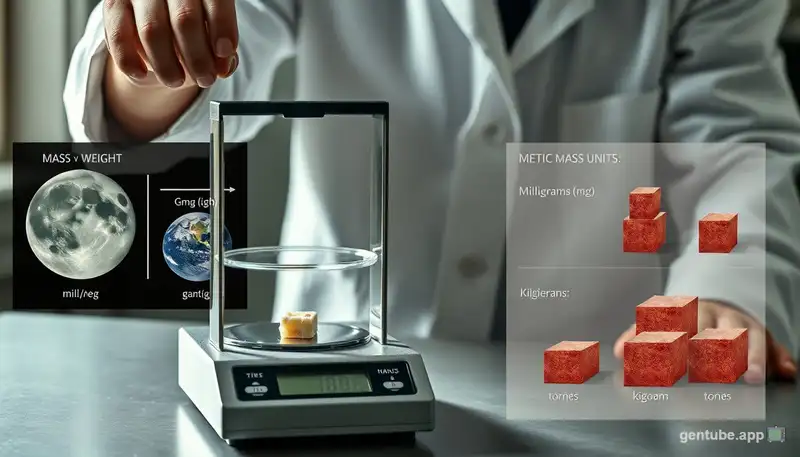
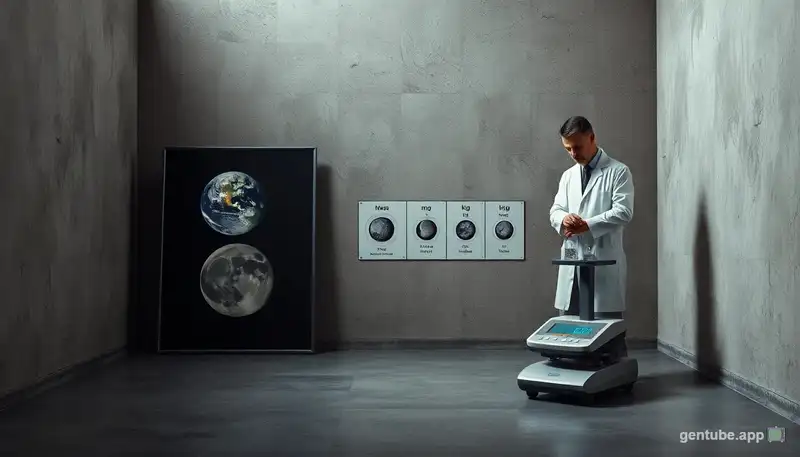
The words mass and weight are frequently used interchangeably, but they are not equivalent. The mass of an object remains constant regardless of where the object is and is, therefore, an intrinsic property of an object. Weight, on the other hand, changes based on gravity, as it is a measure of the gravitational force exerted on an object. This distinction is why scientists and engineers always use mass rather than weight for fundamental calculations.
The force of gravity on the moon, for example, is approximately one-sixth that on earth, due to its smaller mass. This means that a person with a mass of 70 kg on earth would weigh approximately one-sixth of their weight on earth while on the moon. Their mass, however, would still be 70 kg on the moon. This distinction is crucial for scientists, engineers, and anyone working with measurements across different gravitational environments. Even on Earth, gravity varies slightly from place to place — it is about 0.5 percent stronger at the poles than at the equator due to the Earth's rotation and shape.
Weight is calculated using the formula W = m × g, where W is weight, m is mass, and g is the acceleration due to gravity. On Earth, g is approximately 9.81 m/s². So a 70 kg person weighs about 686 newtons on Earth. On Mars, where g is about 3.71 m/s², the same person would weigh only about 260 newtons. Using a mass calculator focuses on the mass component, which stays constant, making it the more fundamental measurement for scientific and industrial applications. In everyday life, when we say we weigh 70 kilograms, we are actually referring to our mass — the scale measures the force of gravity and converts it to a mass equivalent using the standard gravity value.
The Formula for Calculating Mass
While mass is defined by Newton's Second Law, F = ma, in situations where density and volume of the object are known, mass is also commonly calculated using the following equation. This approach is particularly useful when you have access to density tables for common materials but lack a scale to directly measure mass:
In the above equation, m is mass, ρ (rho) is density, and V is volume. The SI unit for density is kilogram per cubic meter, or kg/m³, while volume is expressed in m³, and mass in kg. This formula is fundamental in physics, chemistry, engineering, and materials science.
The mass formula can also be rearranged to solve for density (ρ = m / V) or volume (V = m / ρ), making it a versatile tool for a wide range of scientific calculations. For example, if you know an object has a mass of 100 kg and a volume of 0.5 m³, you can calculate its density as 200 kg/m³. Our density calculator can help you explore this relationship further.
Worked Example
Let us walk through a practical example. Suppose you have a block of aluminum with a volume of 0.1 m³ and you know the density of aluminum is 2,700 kg/m³. Using the mass formula:
This tells you the aluminum block has a mass of 270 kilograms. Using our mass calculator, you can simply enter the density and volume values, select the appropriate units, and get the result instantly in multiple unit systems including kilograms, pounds, and metric tons.
How to Use the Mass Calculator
Using our mass calculator is straightforward. Follow these simple steps to calculate mass from density and volume:
- Enter the density of the material in the density field. Choose from over 30 density units including kg/m³, g/cm³, lb/ft³, and more using the dropdown menu. The default value of 8,900 kg/m³ corresponds to copper, which gives you a familiar reference point.
- Enter the volume of the object in the volume field. Select the appropriate volume unit from cubic meters to liters, gallons, or cubic feet. The default volume is 1 m³, making the result equal to the density value for easy verification.
- Click Calculate or let the calculator update automatically. The mass results appear instantly in the results panel, showing the formula m = ρ × V with the actual values filled in.
- View the results in multiple units simultaneously. The calculator displays mass in kilograms, grams, milligrams, metric tons, pounds, ounces, stones, short tons, long tons, grains, and slugs — eleven different units in total.
The mass formula m = ρ × V is applied automatically, and all unit conversions are handled internally, so you do not need to worry about converting between measurement systems. This makes the mass calculator ideal for students who are still learning unit conversions, as well as professionals who need quick, accurate results. For help with volume measurements for different geometric shapes, check our volume calculator.
Common Units of Mass
Mass can be measured in many different units depending on the context and region. The following are the most common mass units supported by our mass calculator:
- Kilogram (kg) — The SI base unit of mass, used worldwide for scientific and everyday measurements. One kilogram is defined by the Planck constant.
- Gram (g) — One-thousandth of a kilogram, commonly used for cooking, food labels, and small object measurements.
- Metric ton (t) — Equal to 1,000 kilograms, used for large masses like vehicles, shipping containers, and industrial materials.
- Pound (lb) — The standard unit of mass in the imperial system, used primarily in the United States. One pound equals approximately 0.4536 kilograms.
- Ounce (oz) — One-sixteenth of a pound, commonly used for food portions, postal packages, and small items.
- Stone (st) — Equal to 14 pounds, traditionally used in the United Kingdom and Ireland for body weight measurement.
- Short ton (US) — Equal to 2,000 pounds, used in the United States for large quantities.
- Long ton (UK) — Equal to 2,240 pounds, used in the United Kingdom for certain industrial applications.
Our conversion calculator can help you convert between any of these mass units for more specialized applications.
Applications of Mass in Everyday Life
Mass is a fundamental concept that appears in countless everyday situations. Understanding mass and knowing how to calculate it using a mass calculator is valuable in many practical contexts. From the kitchen to the construction site, accurate mass measurements are essential for quality and consistency:
- Cooking and baking — Recipes require precise mass measurements of ingredients for consistent results. Flour, sugar, and butter are commonly measured in grams or ounces. Professional bakers often prefer mass measurements over volume because they are more accurate and reproducible.
- Shipping and logistics — Packages are priced based on their mass. Shipping companies use the mass of parcels to determine costs, and our mass calculator can help estimate shipping weights for any combination of items. Dimensional weight pricing also considers volume, making the mass calculation even more important.
- Fitness and health — Body mass is a key health indicator. BMI calculations, nutritional guidelines, and exercise prescriptions all rely on accurate mass measurements. Tracking changes in body mass over time helps assess the effectiveness of diet and exercise programs.
- Construction and manufacturing — Building materials are specified by their mass per unit volume. Knowing the mass of materials is essential for structural engineering, transportation planning, and cost estimation. Concrete, steel, and lumber are all sold by mass or by products derived from mass calculations.
- Education — Science students regularly calculate mass in physics and chemistry experiments, making a mass calculator a valuable learning tool that helps them focus on concepts rather than arithmetic.
- Jewelry and precious metals — Gold, silver, and platinum are priced by mass. Jewelers and investors use precise mass measurements to determine the value of precious metals. A mass calculator helps convert between troy ounces, grams, and other units used in the precious metals industry.
Mass in Physics and Engineering
In physics and engineering, mass plays a central role in virtually every equation and calculation. Newton's laws of motion, the law of universal gravitation, and the principles of thermodynamics all involve mass as a key variable. Understanding mass and using tools like the mass calculator helps engineers design safer buildings, more efficient vehicles, and more reliable machinery.
In aerospace engineering, precise mass calculations are critical for determining fuel requirements, payload capacities, and orbital mechanics. A spacecraft's mass directly affects how much thrust is needed to launch it into orbit and how much fuel is required for maneuvers. Even a small error in mass estimation can lead to mission failure or excessive fuel costs. Civil engineers calculate the mass of building materials to ensure structural integrity, while mechanical engineers consider mass when designing moving parts to balance forces and minimize energy consumption.
The concept of center of mass is particularly important in engineering. The center of mass is the point where an object's mass is concentrated for the purpose of analyzing its motion. In vehicle design, the center of mass affects stability, handling, and safety. Sports cars are designed with a low center of mass for better cornering, while SUVs have a higher center of mass that requires careful engineering to prevent rollovers. Understanding mass distribution helps engineers optimize designs for performance and safety across countless applications.
In the field of materials science, mass calculations are used to determine the composition of alloys and composite materials. By measuring the mass of a sample and comparing it to known density values, materials scientists can identify unknown substances and verify material purity. This technique, known as density determination, is a standard quality control method in manufacturing industries ranging from automotive to electronics. The mass calculator streamlines this process by providing instant mass values that can be compared against theoretical predictions, helping engineers quickly identify discrepancies in material properties.
Density and Its Relationship to Mass
Density is a measure of how much mass is contained in a given volume. It is expressed as mass per unit volume, typically in kilograms per cubic meter (kg/m³). The relationship between mass, density, and volume is one of the most fundamental in all of science. Different materials have characteristic densities that help identify them and predict their behavior. For example, water has a density of approximately 1,000 kg/m³ at room temperature, while gold has a density of about 19,320 kg/m³ — nearly twenty times denser. This means a gold bar of the same size as a water bottle would have twenty times the mass. Our mass calculator uses this fundamental relationship to compute mass instantly.
The density of a material can change with temperature and pressure. Most materials expand when heated, which decreases their density because the same mass occupies a larger volume. This is why hot air rises — it is less dense than the surrounding cool air. Water is unusual because it reaches its maximum density at 4°C, which is why ice floats — it is less dense than liquid water. Understanding these relationships helps in fields from meteorology to materials science. Engineers must account for thermal expansion when designing bridges, pipelines, and other structures that experience temperature changes.
When using the mass calculator, it is important to use the correct density value for the specific material and conditions you are working with. Density values are typically provided at standard temperature and pressure (STP) of 0°C and 1 atmosphere. If your material is at a different temperature, the actual density may vary. For most practical purposes at room temperature, the standard density values provide sufficiently accurate results for the mass calculator. However, for precision applications like pharmaceutical manufacturing or aerospace engineering, density should be measured under actual operating conditions or adjusted using thermal expansion coefficients.
Mass in Chemistry and Biology
In chemistry, mass is a fundamental quantity used in stoichiometry, solution preparation, and chemical analysis. The mole concept ties the mass of a substance to the number of particles it contains, with one mole of any substance having a mass equal to its molecular weight in grams. When preparing chemical solutions, chemists must accurately measure the mass of solutes to achieve the desired concentration. A mass calculator helps verify these measurements by providing quick conversions between grams, milligrams, and other units commonly used in laboratory settings. For instance, preparing a 1 molar solution of sodium chloride requires exactly 58.44 grams of NaCl per liter of solution, and the mass calculator can confirm this measurement in multiple units.
In biology, mass measurements are essential for studying growth rates, metabolic processes, and ecosystem dynamics. Biologists measure the mass of organisms from microscopic bacteria to massive whales to understand their physiology and ecological roles. The mass of an organism affects its metabolic rate, energy requirements, and many other biological functions. In medical settings, accurate body mass measurements are critical for determining medication dosages, anesthesia requirements, and nutritional needs. The relationship between mass and health is explored in tools like the BMI calculator, which uses mass and height to assess body composition.
Pharmaceutical manufacturing relies on precise mass measurements to ensure each dose of medication contains the correct amount of active ingredient. Even tiny errors in mass measurement can have significant consequences in drug production, which is why pharmaceutical companies use calibrated scales and verification tools. The mass calculator serves as a convenient cross-check for these critical measurements, helping ensure quality control in medical and scientific applications. Quality assurance protocols in pharmaceutical manufacturing often require multiple independent verification steps, and a digital mass calculator provides a quick and reliable second opinion on critical measurements.
Mass Conversion Guide
Converting between different mass units is a common task in science, engineering, and everyday life. Our mass calculator handles these conversions automatically, but understanding the conversion factors is helpful for verifying results and building intuition. Here are some key conversion factors:
- 1 kilogram = 1,000 grams = 2.20462 pounds = 35.274 ounces
- 1 pound = 0.453592 kilograms = 453.592 grams = 16 ounces
- 1 metric ton = 1,000 kilograms = 2,204.62 pounds = 1.10231 short tons
- 1 stone = 14 pounds = 6.35029 kilograms — commonly used in the UK for body weight
- 1 short ton = 2,000 pounds = 907.185 kilograms — used in the United States
- 1 long ton = 2,240 pounds = 1,016.05 kilograms — used in the United Kingdom
- 1 ounce = 28.3495 grams = 0.0625 pounds
- 1 slug = 14.5939 kilograms — used in imperial engineering calculations
When using the mass calculator, you do not need to remember these conversion factors. Simply select the desired density and volume units, and the calculator provides results in every major mass unit simultaneously. This makes it easy to compare values across different measurement systems without manual calculation. For more general unit conversion needs, explore our unit converter.
Common Mistakes When Calculating Mass
Even with a mass calculator, there are common mistakes that can lead to inaccurate results. Being aware of these helps ensure your calculations are correct:
- Unit mismatch — Entering density in kg/m³ but volume in liters without converting. Always check that your density and volume units are compatible before calculating. One milliliter is equivalent to one cubic centimeter, which can help with conversions.
- Confusing mass and weight — Using pounds as a mass unit when the calculation expects kilograms, or vice versa. Remember that pounds can mean either mass or force depending on the context. In scientific settings, use kilograms for mass and newtons for weight.
- Incorrect density values — Using the wrong density for a material. Density varies with temperature, purity, and material grade. Always verify your density source for accuracy. For example, the density of steel ranges from 7,750 to 8,050 kg/m³ depending on the alloy.
- Forgetting decimal places — Small errors in decimal placement can lead to large errors in mass calculations, especially when dealing with very dense or very light materials. A misplaced decimal when entering the density of gold (19,320 vs 1,932) would give a completely wrong result.
- Using volume of container instead of material — When calculating the mass of a granular material like sand, use the material volume, not the container volume, which includes air gaps. The bulk density accounts for these gaps, while the material density does not.
- Assuming uniform density — Many objects are not uniform in composition. A rock may contain multiple minerals with different densities, and the calculated mass using average density is only an approximation.
By avoiding these common pitfalls and using our mass calculator as a verification tool, you can ensure accurate mass calculations for any application.
Final Thoughts
A mass calculator is an essential tool for students, scientists, engineers, and anyone who needs to determine the mass of an object from its density and volume. By understanding the relationship between mass, density, and volume, and by using reliable calculation tools, you can ensure accurate results for any project. Our mass calculator simplifies the process by handling unit conversions across multiple measurement systems and displaying results in eleven different mass units simultaneously, saving you time and reducing the chance of conversion mistakes.
Whether you are a student learning physics, a professional engineer designing a new product, or someone curious about the mass of everyday objects, the mass calculator provides the accuracy and convenience you need. The formula m = ρ × V is fundamental to science, and having a tool that applies it correctly saves time and reduces errors. From determining the mass of construction materials to verifying laboratory measurements, the mass calculator serves a wide range of practical applications across many fields. Try our mass calculator now and see how easy mass calculations can be. For related calculations, explore our weight calculator to understand how mass relates to weight in different gravitational environments, or use the density calculator to solve for density when mass and volume are already known.
To learn more about mass calculator, visit Purplemath.
Frequently Asked Questions
What is the SI unit of mass?
The standard unit of mass under the International System of Units (SI) is the kilogram (kg). It is defined by taking the fixed numerical value of the Planck constant h to be 6.62607015×10⁻³⁴ when expressed in the unit J⋅s, which is equal to kg⋅m²⋅s⁻¹.
How do I calculate mass from density and volume?
To calculate mass, multiply the density (ρ) by the volume (V) using the formula m = ρ × V. Ensure both values use compatible units. For example, if density is in kg/m³ and volume is in m³, the mass will be in kilograms.
What is the difference between mass and weight?
Mass is the amount of matter in an object and remains constant regardless of location. Weight is the force of gravity acting on that mass and changes based on the gravitational field. A person with 70 kg mass weighs about 686 N on Earth but only about 114 N on the Moon.
Can I convert between different mass units using this calculator?
Yes, the mass calculator automatically displays results in kilograms, grams, milligrams, metric tons, pounds, ounces, stones, short tons, long tons, grains, and slugs. Simply enter the density and volume and all conversions update instantly.
What is density and how does it relate to mass?
Density is a measure of how much mass is contained in a given volume, expressed as mass per unit volume (kg/m³). Objects with higher density have more mass packed into the same space. For example, lead (11,340 kg/m³) is much denser than aluminum (2,700 kg/m³), so a lead cube weighs more than an aluminum cube of the same size.
Why does an object's mass stay the same everywhere?
Mass is an intrinsic property of matter determined by the number and type of atoms in an object. Unlike weight, which depends on gravitational pull, mass remains unchanged whether the object is on Earth, the Moon, or in deep space. This is why mass is used for scientific measurements rather than weight.
What units does the mass calculator support for density?
The calculator supports over 30 density units including kg/m³, g/cm³, lb/ft³, oz/gal, and many more. It also supports volume units such as cubic meters, liters, gallons, and cubic feet, ensuring flexibility for any measurement system you need.
How is mass different from volume?
Mass measures the amount of matter in an object, while volume measures the amount of space the object occupies. Two objects can have the same volume but very different masses depending on their density. For instance, a liter of water has a mass of 1 kg, while a liter of mercury has a mass of about 13.5 kg.
What is the formula for mass when force and acceleration are known?
According to Newton's Second Law, mass can be calculated using m = F / a, where F is the net force applied to an object and a is its acceleration. This is the definition of inertial mass and is fundamental to classical mechanics.
Is the mass calculator free to use?
Yes, our mass calculator is completely free to use with no registration or limits. You can calculate mass from density and volume as many times as you need, and all unit conversions are included at no cost.
What is the difference between a kilogram and a pound?
A kilogram is the SI base unit of mass, while a pound is a unit of mass used in the imperial system. One kilogram equals approximately 2.20462 pounds. The calculator handles this conversion automatically in the results section.
Can I use this calculator for chemistry or physics problems?
Our mass calculator is ideal for students and professionals working in chemistry, physics, engineering, and materials science. It handles the wide range of density and volume units commonly used in scientific calculations, reducing the risk of unit conversion errors. Whether you are in a classroom, laboratory, or industrial setting, this tool helps you get accurate results quickly and reliably.