Last updated: June 2026
By CalcOrigin Editorial Team
Right Triangle Basics
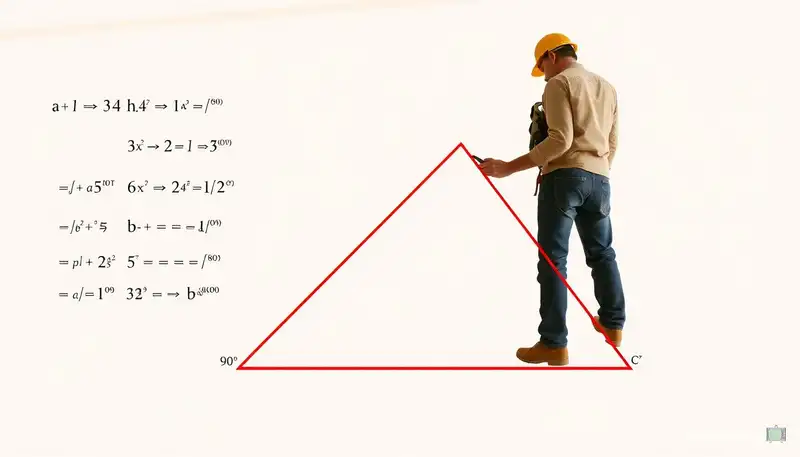
A right triangle is a special type of triangle that has one angle that measures exactly 90°. Right triangles, and the relationships between their sides and angles, are the basis of trigonometry — one of the most important branches of mathematics. In a right triangle, the side opposite the 90° angle is the longest side and is called the hypotenuse. The sides of a right triangle are commonly referred to as a, b, and c, where c is the hypotenuse and a and b are the legs (the sides that form the right angle).
Their angles are also typically referred to using the capitalized letter corresponding to the side length: angle A for side a, angle B for side b, and angle C for side c (which is always 90°). The letter h refers to the altitude of the triangle, which is the perpendicular distance from the vertex of the right angle to the hypotenuse. The altitude divides the original triangle into two smaller right triangles that are similar to each other and similar to the original triangle.
Right triangles have several important properties that distinguish them from other triangles: the two acute angles always sum to 90° (they are complementary), the hypotenuse is always the longest side, and the Pythagorean theorem relates all three sides in a simple equation. These properties make right triangles extremely useful in geometry, engineering, navigation, surveying, construction, and physics.
In any right triangle, the altitude from the right angle to the hypotenuse divides the triangle into two smaller right triangles that are similar to each other and to the original triangle. This similarity relationship gives rise to important proportional relationships known as the geometric mean theorems. These relationships are frequently used in geometric proofs and real-world calculations involving height, distance, and angle measurements.
Right triangles are classified by their angle measures and side relationships. An isosceles right triangle has two equal legs (45-45-90), while a scalene right triangle has legs of different lengths. The most well-known right triangle is the 3-4-5 triangle, which has been used since ancient times by Egyptian and Greek builders to create right angles.
The right triangle calculator on this page uses all these relationships to compute unknown values. Enter any two known values to instantly find the missing sides, angles, area, perimeter, altitude, inradius, and circumradius. The results include step-by-step explanations showing exactly which formulas were applied and how each value was derived.
Pythagorean Theorem
The Pythagorean theorem is a fundamental relation in Euclidean geometry among the three sides of a right triangle. It states that the square of the hypotenuse equals the sum of the squares of the other two sides:
a² + b² = c²
Where a and b are the legs and c is the hypotenuse. This formula allows you to find the length of any side if you know the other two. To find the hypotenuse: c = √(a² + b²). To find a missing leg: a = √(c² - b²).
Example — 3-4-5 right triangle:
3² + 4² = 9 + 16 = 25 = 5²
If all three sides of a right triangle are integers, it is called a Pythagorean triangle and the side lengths form a Pythagorean triple. Common examples include (3, 4, 5), (5, 12, 13), (8, 15, 17), and (7, 24, 25). Pythagorean triples have been studied since ancient times, and there are infinitely many of them. Euclid's formula generates all primitive Pythagorean triples using two positive integers m and n where m > n: a = m² - n², b = 2mn, c = m² + n².
To find a missing side using the Pythagorean theorem, rearrange the formula. To find the hypotenuse when both legs are known: c = √(a² + b²). To find a missing leg when the hypotenuse and one leg are known: a = √(c² - b²) or b = √(c² - a²). These calculations involve square roots, which our calculator handles automatically.
Our right triangle calculator applies the Pythagorean theorem automatically. You can also use our dedicated Pythagorean theorem calculator for problems focused specifically on finding missing sides.
Right Triangle Area and Perimeter
The area of a right triangle is calculated the same way as any triangle — half the base times height. However, since the two legs are perpendicular to each other, they serve as natural base and height pairs:
A = ½ × a × b
Where a and b are the lengths of the two legs. This is the simplest and most commonly used formula for right triangle area. You can also use the hypotenuse and its altitude:
A = ½ × c × h
The perimeter is the sum of all three sides:
P = a + b + c
Example: A right triangle with legs of 3 and 4 has a hypotenuse of 5 (a 3-4-5 Pythagorean triple). Its area is ½ × 3 × 4 = 6 square units. Its perimeter is 3 + 4 + 5 = 12 units. The altitude to the hypotenuse is h = (3 × 4) / 5 = 2.4 units, and using the alternative area formula: ½ × 5 × 2.4 = 6 square units, confirming the result. The inradius is r = (3 + 4 - 5) / 2 = 1 unit, meaning a circle of radius 1 fits perfectly inside this triangle.
You can verify any right triangle area using Heron's formula as well: A = √(s(s-a)(s-b)(s-c)) where s is the semiperimeter. For the 3-4-5 triangle, s = 6, so A = √(6 × 3 × 2 × 1) = √36 = 6, confirming our result.
Our right triangle calculator computes area and perimeter automatically using these formulas, along with all other triangle properties.
Special Right Triangles
Special right triangles have fixed angle measures and consistent side ratios that make them easy to work with. Two types appear frequently in geometry, trigonometry, and standardized tests.
30°-60°-90° Triangle
The 30°-60°-90° triangle has angles in a 1:2:3 ratio and side lengths in a fixed ratio of 1:√3:2. The shortest side is opposite the 30° angle, the medium side is opposite the 60° angle, and the hypotenuse is opposite the 90° angle. This triangle is formed when an equilateral triangle is bisected along its altitude.
Side ratio: 1 : √3 : 2
If the shortest side (opposite 30°) is x, then the hypotenuse is 2x and the remaining side (opposite 60°) is x√3. For example, if the shortest side is 5, the hypotenuse is 10 and the remaining side is 5√3 ≈ 8.66. These triangles are commonly used in construction, engineering, and navigation problems.
45°-45°-90° Triangle
The 45°-45°-90° triangle, also called an isosceles right triangle, has two equal sides and two equal angles. The side ratio is 1:1:√2, where the two legs are equal and the hypotenuse is √2 times the leg length. This triangle is formed when a square is divided along its diagonal.
Side ratio: 1 : 1 : √2
If each leg is x, then the hypotenuse is x√2. For example, a 45-45-90 triangle with legs of 7 has a hypotenuse of 7√2 ≈ 9.90. Conversely, if the hypotenuse is known, each leg = c / √2. These triangles appear frequently in geometry problems, construction layout, and design work where right angles need to be precisely measured.
How to Use the Right Triangle Calculator
Using the right triangle calculator is straightforward. Enter any two values from the available input fields — sides (a, b, c), angles (α, β), altitude (h), area (A), or perimeter (P). At least one side must be provided. The calculator will compute all remaining values using the Pythagorean theorem, trigonometric functions, and geometric formulas automatically.
The input form allows several convenient combinations: two sides, one side and one acute angle, one side and the altitude, one side and the area, or one side and the perimeter. The calculator intelligently determines which formulas to apply based on your inputs. If you enter two sides, it recognizes this as an opportunity to use the Pythagorean theorem. If you enter a side and an angle, it applies sine, cosine, or tangent as appropriate.
The calculator supports degree and radian angle units. Select the appropriate unit from the dropdown next to each angle input. Common radian values like π/3, π/4, and π/6 are accepted. The triangle diagram updates in real time to reflect your inputs, showing the current triangle with labeled sides and angles.
Click "Show Calculation Steps" to see the complete step-by-step process, including which formulas were used and how each value was derived. This is especially useful for students learning right triangle geometry, as it reinforces the relationships between sides, angles, area, and other properties. You can follow along with each calculation to verify your own work and deepen your understanding of right triangle mathematics.
Trigonometric Ratios in Right Triangles
Right triangles form the foundation of trigonometry. The three primary trigonometric ratios relate the angles to the side lengths and are defined using the sides of a right triangle relative to a specific acute angle:
- Sine (sin): sin(θ) = opposite / hypotenuse — relates the opposite side to the hypotenuse
- Cosine (cos): cos(θ) = adjacent / hypotenuse — relates the adjacent side to the hypotenuse
- Tangent (tan): tan(θ) = opposite / adjacent — relates the opposite side to the adjacent side
The mnemonic SOH-CAH-TOA helps remember these ratios: Sine is Opposite over Hypotenuse, Cosine is Adjacent over Hypotenuse, Tangent is Opposite over Adjacent.
These ratios allow you to find any missing side or angle when you know one side and one acute angle. For example, if you know angle α and side a (the side opposite α), you can find side c using c = a / sin(α), and side b using b = a / tan(α). If you know angle α and side b (adjacent to α), then side a = b × tan(α) and side c = b / cos(α). These relationships form the core of right triangle trigonometry and are used in countless practical applications.
The inverse trigonometric functions — arcsin, arccos, and arctan (also written as sin⁻¹, cos⁻¹, and tan⁻¹) — allow you to find an angle when you know two sides. For instance, if you know sides a and c, then angle α = arcsin(a / c). If you know sides a and b, then angle α = arctan(a / b). These inverse functions are essential for solving right triangles when side lengths are known but angles are not.
Three important trigonometric identities that apply to right triangles are the reciprocal, quotient, and Pythagorean identities. The most fundamental is the Pythagorean identity: sin²(θ) + cos²(θ) = 1, which follows directly from the Pythagorean theorem. This identity is useful for verifying solutions and for converting between sine and cosine values.
The right triangle calculator applies all these relationships automatically based on your inputs. Simply enter your known values and the calculator determines which trigonometric functions to apply, whether you need sine, cosine, tangent, or their inverses.
For more advanced trigonometric calculations including inverse functions, graphing, and complex number operations, try our scientific calculator.
For more advanced trigonometric calculations including inverse functions and graphing, try our scientific calculator.
Common Mistakes When Solving Right Triangles
When working with right triangles, several common errors can lead to incorrect results. Being aware of these mistakes will help you use the right triangle calculator more effectively:
- Confusing which side is the hypotenuse: The hypotenuse is always opposite the 90° angle and is the longest side. Make sure c is always the hypotenuse when applying the Pythagorean theorem. A common error is to misidentify the longest side when the triangle is drawn in an unusual orientation.
- Using the wrong trig ratio: Check which sides you know relative to the angle. SOH-CAH-TOA is a helpful mnemonic: Sine = Opposite/Hypotenuse, Cosine = Adjacent/Hypotenuse, Tangent = Opposite/Adjacent. Practice identifying opposite and adjacent sides relative to the given angle.
- Forgetting angle units: When calculating trigonometric functions, ensure your calculator is in the correct mode (degrees or radians). Mixing them up will give dramatically wrong results. For example, sin(30°) = 0.5 but sin(30 radians) ≈ -0.988.
- Applying Pythagoras to non-right triangles: The Pythagorean theorem only works for right triangles. For other triangles, use the triangle calculator which applies the law of cosines: c² = a² + b² - 2ab × cos(C).
- Rounding intermediate results: Rounding values too early in multi-step calculations can compound errors. Keep full precision until the final step, then round to the appropriate number of decimal places.
- Using the wrong side as the altitude base: The altitude of a right triangle is measured from the right angle vertex to the hypotenuse, not from one of the acute angle vertices.
Right Triangles in Real Life
Right triangles appear everywhere in the real world, making the right triangle calculator a practical tool for many professions and everyday situations. Understanding how right triangles work gives you a powerful mental framework for solving spatial problems:
- Construction and architecture: Builders use the 3-4-5 rule to ensure corners are perfectly square. Roof rafters, staircases, and ramps all form right triangles that require precise angle and length calculations for safety and structural integrity. Carpenters regularly use right triangle geometry when cutting rafters and framing walls.
- Navigation and GPS: Triangulation using right triangles helps determine positions on maps and GPS coordinates. Surveyors measure distances and elevations using right triangle trigonometry with instruments like theodolites. The difference in elevation between two points can be found using the slope distance and the vertical angle.
- Engineering and physics: Structural engineers calculate forces in trusses, bridges, and support beams using right triangle relationships. Vector decomposition in physics relies on right triangles — any force vector can be broken down into horizontal and vertical components that form a right triangle.
- Everyday measurements: Finding the height of a tree or building using its shadow involves similar right triangles. Ladder placement against a wall creates a right triangle where the wall and ground are the legs and the ladder is the hypotenuse. The optimal ladder angle is around 75 degrees for safety.
Altitude to the Hypotenuse
The altitude (h) of a right triangle is the perpendicular distance from the right angle vertex to the hypotenuse. It is an important geometric property with several interesting relationships and applications:
h = (a × b) / c
The altitude divides the original right triangle into two smaller right triangles that are similar to each other and similar to the original triangle. This means the ratios of corresponding sides are equal, which gives us additional relationships known as the geometric mean theorems.
If the altitude divides the hypotenuse into segments p and q (where p is adjacent to side a and q is adjacent to side b), then:
- Altitude theorem: h² = p × q — the altitude is the geometric mean of the two hypotenuse segments.
- Leg theorem: a² = c × p and b² = c × q — each leg is the geometric mean of the hypotenuse and its adjacent segment.
Example: In a 3-4-5 right triangle, the altitude to the hypotenuse is h = (3 × 4) / 5 = 12/5 = 2.4. If we label the segments of the hypotenuse as p and q, where p is adjacent to the side of 3 and q is adjacent to the side of 4, then altitude theorem gives: h² = p × q. We can verify: p = a² / c = 9/5 = 1.8 and q = b² / c = 16/5 = 3.2, so p × q = 1.8 × 3.2 = 5.76 = 2.4² = h².
These relationships are known as the geometric mean theorem or the altitude-on-hypotenuse theorem. They are frequently tested in geometry exams and have practical applications in construction and design. The altitude divides the right triangle into two smaller triangles that share proportional relationships with the original, enabling indirect measurements and calculations in real-world scenarios.
Our right triangle calculator computes the altitude automatically when you enter the side lengths, along with the segments of the hypotenuse that the altitude creates.
Inradius and Circumradius of Right Triangles
The inradius (r) of a right triangle is the radius of the inscribed circle that touches all three sides internally. This circle is tangent to all three sides, and its center is located at the intersection of the angle bisectors. For a right triangle, the inradius can be calculated using the formula:
r = (a + b - c) / 2
Where a and b are the legs and c is the hypotenuse. The inradius is also related to the area and semiperimeter (s): r = A / s, where s = (a + b + c) / 2. This means the inscribed circle's radius depends on the triangle's overall dimensions. For a 3-4-5 triangle, the inradius is r = (3 + 4 - 5) / 2 = 1, meaning a circle of radius 1 fits perfectly inside the triangle.
The circumradius (R) is the radius of the circumscribed circle that passes through all three vertices. For a right triangle, the hypotenuse is the diameter of the circumcircle, giving the simple relationship:
R = c / 2
This means the midpoint of the hypotenuse is the center of the circumscribed circle. This property is unique to right triangles — no other triangle type has its circumcenter on one of its sides. It is a common result used in geometry proofs and exam problems.
The right triangle calculator computes both the inradius and circumradius automatically, giving you a complete picture of the triangle's geometric properties.
Common Right Triangle Problems
Here are typical right triangle problems you might encounter and how to solve them using our right triangle calculator:
- Given two legs, find the hypotenuse: Enter sides a and b. The calculator uses the Pythagorean theorem c = √(a² + b²) to find the hypotenuse, then computes all angles using inverse trigonometric functions. For example, angle α = arcsin(a/c).
- Given one leg and the hypotenuse, find the other leg: Enter side a and side c. The calculator finds b = √(c² - a²) using the rearranged Pythagorean theorem and computes all remaining values including angles, area, and perimeter.
- Given one side and one angle, find everything: Enter any side and one acute angle. The calculator uses trigonometric ratios to find all remaining values. For example, if you know side a and angle α, then c = a / sin(α) and b = a / tan(α).
- Given area and one side, find the other values: Enter area and one side. The calculator works backward from the area formula A = ½ × a × b to determine the missing leg, then uses Pythagoras to find the hypotenuse and all other properties.
- Given perimeter and one side: Enter the perimeter and one side. The calculator solves the system of equations formed by the perimeter formula (P = a + b + c) and the Pythagorean theorem to find all dimensions.
Each of these problem types is handled automatically by the calculator. Simply enter your known values and the calculator determines which approach to use based on the combination of inputs provided. This flexibility makes the right triangle calculator suitable for a wide range of problems, from simple homework checks to complex engineering calculations.
Final Thoughts — Mastering Right Triangles
Right triangles are one of the most fundamental shapes in geometry, forming the basis of trigonometry and appearing in countless real-world applications. Understanding how to calculate their sides, angles, area, and other properties is an essential mathematical skill.
Our free right triangle calculator makes these calculations instant and accurate. Whether you are a student learning the Pythagorean theorem for the first time, a teacher preparing geometry lessons, a carpenter checking square corners, a surveyor measuring land, or an engineer designing structures, this tool provides reliable results with detailed step-by-step solutions.
By understanding the relationships between sides, angles, area, altitude, inradius, and circumradius, you develop a complete understanding of right triangle geometry. Each calculation reinforces the mathematical principles that make right triangles one of the most useful shapes in all of mathematics. Whether you are solving a geometry problem, checking a construction measurement, or exploring mathematical relationships, right triangles provide a reliable foundation for your work.
We encourage you to experiment with the calculator — try different input combinations and observe how changing one value affects the others. This interactive exploration is one of the best ways to develop intuition for right triangle relationships and build confidence in applying these concepts to real problems.
Explore our other geometry calculators including the triangle calculator for non-right triangles (which uses the law of cosines and law of sines), the Pythagorean theorem calculator for focused missing-side problems, area calculator for various shapes, and geometry calculator for more complex shape calculations.
To learn more about right triangle calculator, visit BYJU'S.