Last updated: June 2026
By CalcOrigin Editorial Team
About Tip Calculator
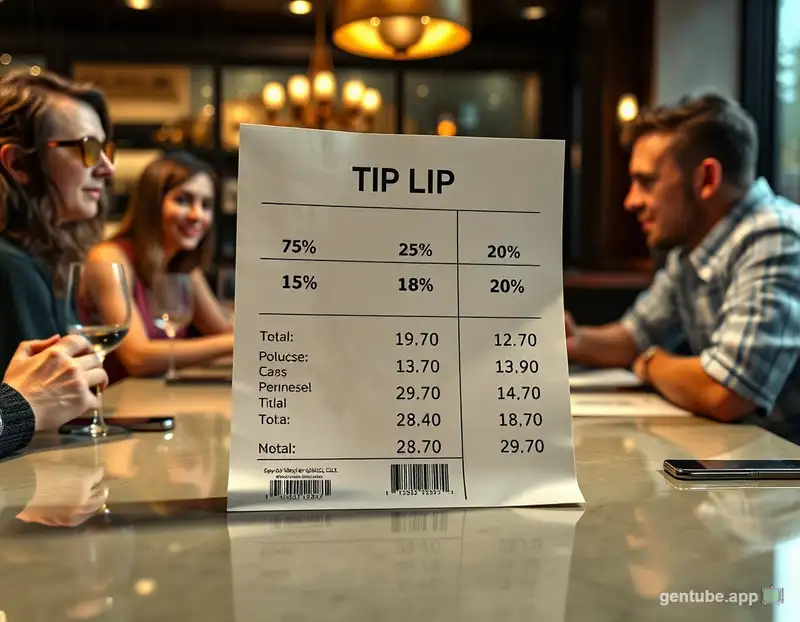
A tip or gratuity is an extra sum of money paid to certain service workers for a provided service. Tip amounts, as well as acceptance, vary in different parts of the world. The Tip Calculator on this page makes it easy to determine the appropriate tip for any bill amount, whether you are dining out, ordering delivery, or using personal services. Simply enter your bill total, and the calculator displays a full breakdown of tip amounts from 5% to 30% along with the total including the gratuity.
Using a Tip Calculator eliminates the mental math and uncertainty that often comes with tipping. Instead of trying to calculate percentages in your head or fumbling with your phone at the end of a meal, you can quickly reference the exact amounts. This is especially helpful when dining with a group, where the bill may need to be split evenly or when different people want to tip different percentages. For group dining, the Shared Bill Tip Calculator section handles splitting the total, tip, and per-person amounts automatically.
Tipping is more than just a calculation it is a social norm that shows appreciation for good service. In the United States, service workers in restaurants often rely on tips as a significant portion of their income, with many earning a base wage well below minimum wage. The standard tip for sit-down restaurant service has risen from 15% to 18-20% in recent years, reflecting changing expectations and economic conditions. Understanding standard tipping practices and using a reliable calculator helps you navigate these situations with confidence. For related financial calculations, check our Sales Tax Calculator to see how taxes affect your total dining cost.
Beyond restaurants, the Tip Calculator is useful for a wide range of service industries including food delivery, haircuts, spa services, hotel staff, and transportation. Each industry has its own tipping conventions, and the calculator helps you determine the right amount for any percentage. By entering different tip percentages, you can see how the tip amount changes and decide what feels appropriate based on the quality of service you received. This flexibility makes the Tip Calculator a versatile tool for everyday use. Whether you need a quick restaurant tip calculation or a detailed split bill breakdown for a group dinner, this tool has you covered.
How the Tip Calculator Works
The Tip Calculator works by taking your bill amount and applying standard tip percentages to calculate the gratuity and total. For the basic calculator, you enter the price of the service, and the tool instantly computes the tip and total for seven common percentages: 5%, 10%, 15%, 18%, 20%, 25%, and 30%. The 15% row is highlighted as the standard recommended tip for restaurant service in the United States.
The Shared Bill Tip Calculator extends this functionality for group situations. You enter the total bill amount, the desired tip percentage, and the number of people splitting the bill. The calculator then shows the tip per person, total per person, total bill including tip, and total tip amount. This is perfect for dinner parties, group outings, or any situation where the bill needs to be divided evenly. The calculator handles all the math so you can focus on enjoying your meal.
Behind the scenes, the calculator uses simple multiplication and division. The tip is calculated as bill amount times tip percentage divided by 100. For the shared bill, the tip and total are further divided by the number of people. While the math is straightforward, the Tip Calculator eliminates human error and provides instant results. The basic calculator updates automatically as you type, showing all seven tip percentages simultaneously so you can compare options at a glance. This real-time feedback helps you decide quickly without pressing any additional buttons or performing manual calculations.
The Shared Bill Tip Calculator is particularly valuable for group dining scenarios where the math can become complicated. If you are dining with five friends and the total bill is $125 with an 18% tip, the total tip is $22.50 and each person owes $29.50 including their share of the tip. Without a calculator, figuring this out at the table can be awkward and time-consuming. The shared bill calculator handles this instantly, allowing you to focus on the social experience rather than the arithmetic. For more financial calculations involving percentages, explore our Discount Calculator to see how percentages work in reverse for savings.
Tipping Customs Around the World
In some countries in East Asia, such as Japan, tips are seen as insulting and can sometimes be interpreted as a bribe. In the United States, tipping is widely expected, and in many cases, is even factored into a service worker's compensation. In European countries, a service charge is often included in the bill, though leaving spare change is still common. In Australia and New Zealand, tipping is not traditionally expected but is appreciated for exceptional service. Understanding these cultural differences is essential when traveling internationally.
When traveling abroad, research the local tipping customs before you arrive to avoid awkward situations. In Japan and South Korea, excellent service is considered standard and expected, so tipping can imply that the worker does not earn enough. In many European countries, rounding up the bill or leaving a few euros is common for good service, but 15-20% tipping is not the norm as it is in the US. In Canada, tipping practices are very similar to the US, with 15-20% being standard at restaurants. Using the Tip Calculator with a lower percentage can help you adjust to local customs while still showing appreciation.
In Latin American countries, tipping practices vary widely. In Mexico, a 10-15% tip is standard at restaurants, while in Brazil, a 10% service charge is often included in the bill automatically. In many Caribbean nations, tipping is expected and similar to US customs due to the tourism industry. In Australia and New Zealand, tipping is not traditionally expected but is welcomed for exceptional service. Understanding these regional differences ensures you tip appropriately wherever your travels take you.
Split Bill Etiquette
Splitting a restaurant bill among friends or colleagues can be a source of social friction, but the Shared Bill Tip Calculator makes it simple and fair. The most common approach is to split the total bill including tip evenly among all diners. This works well when everyone has ordered items of similar cost. When the amounts vary significantly, some groups prefer each person to pay for their own share plus an equal portion of the tip, or for each person to tip individually on their portion. Being transparent about the calculation method prevents misunderstandings and keeps the focus on enjoying the meal together.
When using the Shared Bill Tip Calculator, enter the total bill amount, the desired tip percentage, and the number of people. The calculator instantly shows each person's share of the tip and total. If your group prefers different tipping percentages, use the basic Tip Calculator first to find the total including each person's preferred tip, then divide manually. Some groups agree on a single tip percentage for simplicity, typically 18% or 20% for good service. Others prefer to let each person tip according to their satisfaction level, which the basic calculator supports by showing multiple percentage options.
There are also digital payment apps and services that facilitate bill splitting, but understanding the underlying math helps you verify the amounts are correct. When in doubt, use the Tip Calculator to confirm that everyone is paying their fair share. For additional help with financial calculations related to group expenses, try our Split Bill Calculator for more detailed bill division scenarios. You can also use our Budget Calculator to track how much you spend on dining out and tips each month.
Common Tipping Mistakes to Avoid
Even with the best intentions, many people make common mistakes when calculating tips. Being aware of these pitfalls will help you handle tipping situations more gracefully and ensure service workers are compensated fairly. The Tip Calculator helps you avoid these errors by doing the math for you.
- Tipping on the wrong amount. Always tip on the pre-tax bill amount, not the total after tax. Tipping on tax inflates the tip unnecessarily. The Tip Calculator assumes you are entering the pre-tax amount for accurate results.
- Forgetting to adjust for large groups. Many restaurants automatically add a gratuity of 18% or 20% for parties of six or more. Check your bill before adding an additional tip to avoid double-tipping. If the auto-gratuity is already included, you do not need to add more unless you feel the service was exceptional.
- Using outdated tipping percentages. While 15% was once standard, the expected tip has risen to 18-20% for good service in most US restaurants. Adjust your tip percentage accordingly. Using the Tip Calculator with different percentages helps you see how much difference a few percentage points make.
- Not tipping on the full service amount. When using a coupon or discount, tip based on the original price of the service, not the discounted amount. The service worker provided the same level of service regardless of any promotions.
- Ignoring tip etiquette when traveling. Different countries have different tipping norms. Research local customs before traveling to avoid over-tipping or under-tipping in foreign countries. The Tip Calculator can help you adjust to the appropriate percentage for your destination.
- Forgetting to tip for services rendered in your home. Many people forget to tip home service providers like movers, furniture delivery personnel, appliance installers, and home cleaners. These workers often rely on tips just as much as restaurant staff, and a tip of $5-20 per person is standard depending on the complexity of the job.
Tipping Guide by Service
| Service |
Typical Tip |
| Restaurants, Bartenders | 15%-20% |
| Food Delivery | 15%-20% |
| Hotel Room Service | 15-20% (if not included) |
| Hotel Housekeeping | $1-$2 per night |
| Automotive Services, Mechanic | Not expected or a few dollars |
| Movers, Furniture Delivery | $5-$20 each |
| Home Services | $5-$20 each |
| Hairstylists, Barber, Nail | 10%-20% |
| Massage | 10%-20% |
| Taxi or Limo Drivers | 15%-20% |
| Shuttle Drivers, Parking | $1-$3 |
| Tour Guides | $1-$5 per tour |
General Tipping Etiquette
Beyond knowing the percentages, understanding tipping etiquette helps you navigate social situations with confidence. The basic rule of thumb in the United States is to tip 15-20% at restaurants for sit-down service, 10-15% for food delivery, and $1-5 per service for hotel staff, movers, and similar service providers. When in doubt, asking the establishment about their tipping policy is always acceptable. These guidelines provide a solid foundation for appropriate tipping in most everyday situations across different service categories.
For exceptional service, tipping above the standard range is always appreciated. If your server went above and beyond, consider 25% or more. Conversely, if the service was poor, it is generally acceptable to tip less, but leaving no tip at all should be reserved for truly egregious service. Keep in mind that many service workers depend on tips as a primary source of income. The Tip Calculator makes it easy to adjust your tip percentage and see the resulting amounts instantly.
Special situations also warrant consideration. For buffets, a tip of 10% is standard for the staff who clear your plates and refill drinks. For catered events, the gratuity is often included in the contract, but additional tips for individual servers are appreciated. For holiday tipping, many people give regular service providers such as mail carriers, newspaper delivery, and personal care workers an extra cash gift during the holiday season. The amount is typically equivalent to one service session or a small cash gift of $10-50. Some restaurants add a service charge for large parties, so always review your bill to understand what fees have already been included before adding your tip.
How to Calculate a Tip Quickly
While the Tip Calculator handles the math for you, knowing how to estimate a tip quickly is a useful skill for situations where you do not have access to the calculator. The most common method is the 10% trick. To find 10% of any bill, simply move the decimal point one place to the left. For a $47.50 bill, 10% is $4.75. To find 20%, double that amount to get $9.50. For 15%, add 10% and half of 10%: $4.75 + $2.38 = $7.13. These mental math shortcuts work well for any bill amount.
A more precise approach is to round the bill to the nearest easy number before calculating. For example, a bill of $48.23 can be rounded to $48 for easier math. Ten percent is $4.80, twenty percent is $9.60, and fifteen percent is $7.20. The slight rounding error is negligible for practical purposes and makes the calculation much faster. When dining with a group, you can calculate the total per person by dividing the estimated total by the number of people.
For those who prefer a more exact calculation, multiply the bill amount by the tip percentage expressed as a decimal. For a $55 bill at 18%, multiply 55 by 0.18 to get $9.90. Add that to the bill to get the total of $64.90. Over time, these calculations become second nature with regular practice. Using the Tip Calculator regularly helps you develop a sense for common tip amounts, making you quicker at estimating even when you are not using the tool directly.
Tipping for Different Occasions
Tipping practices vary significantly depending on the type of service and occasion. At full-service restaurants, the standard tip is 15-20% of the pre-tax bill. For large parties, check whether a gratuity has already been added to the bill before adding an additional tip. At bars, tipping $1-2 per drink or 15-20% of the total tab is standard. For high-end cocktail bars where drinks require more preparation, tipping 20% or more is appreciated.
For food delivery services, the standard tip is 15-20% of the order total, with a minimum of $3-5 for smaller orders. Delivery drivers often rely on tips for a significant portion of their income. For takeout orders where you pick up the food yourself, a smaller tip of 10% or a few dollars is still appreciated by the staff who package your order. Many people overlook tipping for takeout, but the kitchen and counter staff still provide a service that deserves recognition. A good rule for any restaurant tip is to base it on the quality of service rather than the total bill amount alone.
Personal care services like haircuts, manicures, and massages typically warrant a tip of 15-20% of the service price. For spa services, this percentage applies to the pre-tax service cost, and many spas provide envelopes for tips at the front desk. For hotel services, tip $1-2 per night for housekeeping, $1-2 per bag for bellhops, and $5-10 for valet parking. For tour guides, $5-10 per person for a half-day tour and $10-20 per person for a full-day tour is standard.
Seasonal and holiday tipping deserves special consideration. Many people choose to give extra tips to regular service providers during the holiday season as a thank you for consistent service throughout the year. Common recipients include mail carriers, newspaper delivery personnel, building superintendents, doormen, garbage collectors, and regular house cleaners. The amount typically ranges from $10 to $50 depending on the frequency of service and your relationship with the provider. Some apartment buildings have specific policies about holiday tipping, so check with your building management if you are unsure about appropriate amounts.
Digital Tipping and Payment Apps
Modern technology has transformed the way we handle tips. Digital payment systems at restaurants often present suggested tip amounts of 18%, 20%, and 25% when you pay by credit card. These suggestions are calculated on the total after tax, so be aware that tipping on tax inflates the tip amount slightly. The Tip Calculator shows tips based on the pre-tax bill, giving you a more accurate baseline for comparison with the digital suggestions. This difference can amount to several dollars on a large bill, making it worth understanding which method you are using.
Many service workers now accept digital payments and tips through apps like Venmo, PayPal, and Cash App. These platforms make it easy to send a tip even if you do not have cash on hand. Some restaurants and services have integrated digital tipping directly into their payment systems, allowing you to add a tip before you even leave the establishment. When using these systems, verify the tip percentage being applied to avoid over-tipping accidentally. Some digital payment screens default to higher percentages like 22% or 25%, so always double-check before confirming.
For gig economy services like ridesharing, food delivery, and task-based platforms, tipping is typically done through the app after the service is complete. Most of these platforms default to suggested tip amounts of 15%, 20%, or 25%. Drivers and delivery workers see your tip after completing the service, and tipping well can lead to better service in the future. The Tip Calculator helps you determine the right amount regardless of which platform or payment method you are using. With the rise of cashless transactions, having a reliable way to calculate tips has become more important than ever, since you cannot simply leave coins on the table as in previous decades.
The History of Tipping
Tipping has a long and complex history that dates back centuries. The practice is believed to have originated in 16th century England, where house guests would give vails or small sums of money to household staff for exceptional service. The word tip itself may have originated as an acronym for To Insure Promptitude, though linguists generally believe it derives from the English slang term to tip meaning to give or pass along. From England, the practice spread to other parts of Europe and eventually to the United States. Understanding this history provides context for why different cultures approach tipping so differently today.
In the United States, tipping became widespread after the Civil War. The federal minimum wage for tipped workers in the US remains at $2.13 per hour, a rate that has not changed since 1991. This means service workers rely almost entirely on tips for their income, making the Tip Calculator not just a convenience but a practical tool for ensuring fair compensation. Understanding this context helps explain why tipping is such an important part of American culture and why accurate calculation matters.
Different countries have different tipping histories and norms. In Japan, the concept of excellent service being included in the price means tipping is not practiced. In many European countries, a service charge is included in the bill, and any additional tip is modest. Understanding the history behind these practices helps explain why tipping can be so confusing for international travelers. Regardless of where you are or the local customs, the Tip Calculator helps you navigate tipping situations with confidence and cultural awareness.
Tipping practices continue to evolve in the modern era. The COVID-19 pandemic led to increased awareness of service workers contributions and many people began tipping more generously as a result. New digital tipping prompts at coffee shops, fast casual restaurants, and even retail stores have expanded the situations where tipping is expected. As social norms change, staying informed about current tipping expectations helps you navigate these situations appropriately, and the Tip Calculator gives you the flexibility to adjust to any standard.
Final Thoughts on Using the Tip Calculator
The Tip Calculator on this page gives you everything you need to handle tipping situations with ease and confidence. Whether you are calculating a quick tip for a solo dinner, splitting a bill among a large group, or familiarizing yourself with tipping customs around the world, this tool provides accurate results in seconds. The basic calculator shows a full range of tip percentages, while the shared bill calculator handles group scenarios effortlessly.
Bookmark this page for quick reference whenever you dine out, order delivery, or use personal services. The more you use the Tip Calculator, the more natural the percentages will become, and soon you will be able to estimate tips quickly even without the calculator. Understanding tipping norms and calculating accurately not only ensures you are fair to service workers but also helps you budget your dining and service expenses more effectively. The difference between tipping 15% and 20% on a $100 bill is only $5, but for service workers, every dollar counts toward their livelihood.
Start using the Tip Calculator today to take the stress out of tipping. Whether you are a seasoned diner or new to tipping, this tool helps you navigate every situation appropriately. For more tools to help manage your finances, visit our Financial Calculators page or explore the full collection of calculators available on CalcOrigin. With practice, you will develop confidence in your tipping decisions and never have to guess the right amount again. Knowing the right tip percentage for every service ensures you show appreciation appropriately without overthinking the math at the table.
To learn more about tip calculator, visit SEC.gov.
Frequently Asked Questions
What is a standard tip amount?
In the U.S., the standard tip for good service at a restaurant is 15-20% of the pre-tax bill. For excellent service, 20% or more is appropriate.
Should I tip for takeout?
For takeout orders, a small tip of 10% or a few dollars is appreciated, especially for larger orders.
How do I calculate tip on tax?
Tip should be calculated on the pre-tax amount, not the total after tax. Our calculator does this automatically.
What percentage should I tip for food delivery?
For food delivery services like DoorDash, Uber Eats, and Grubhub, the standard tip is 15-20% of the order total. A minimum tip of $3-5 is recommended for smaller orders since delivery drivers rely heavily on tips as part of their compensation.
Do I need to tip for catering or large events?
For catered events, a gratuity of 15-20% is often included in the contract. Check your agreement before adding an additional tip. If the gratuity is not included, tipping 15-20% of the total catering cost is standard, distributed among the serving staff.
How much should I tip a hairstylist or barber?
The standard tip for hairstylists, barbers, and nail technicians is 15-20% of the service price. For excellent service or complex treatments, 20-25% is appreciated. Many clients tip on the total before any discounts or promotions are applied.
What is the etiquette for tipping at hotels?
Hotel tipping varies by service: $1-2 per night for housekeeping, $1-2 per bag for bellhops, $5-10 for valet parking, and $5-20 for concierge services depending on the complexity of the request. For room service, check if a gratuity is already included in the delivery charge.
Should I tip on the pre-tax or post-tax amount?
You should always calculate your tip based on the pre-tax bill amount, not the total after tax. Tipping on tax unnecessarily inflates the gratuity. Our Tip Calculator assumes you are entering the pre-tax amount for accurate results.
Is tipping expected for moving or furniture delivery?
Yes, tipping movers and furniture delivery personnel is standard. For movers, tip $20-50 per person depending on the complexity of the move. For furniture delivery, $5-20 per person is appropriate. These workers often perform physically demanding labor and tips are a meaningful part of their income.
How do I handle tipping when dining with a large group?
For groups of six or more, many restaurants automatically add a gratuity of 18-20% to the bill. Check your receipt carefully before adding an additional tip. If no auto-gratuity is included, the standard 18-20% applies. Use our Shared Bill Tip Calculator to split the total evenly among all guests.
What is the difference between a tip and a service charge?
A service charge is a mandatory fee added by the establishment, often for large parties or special events. A tip or gratuity is voluntary and given at the customers discretion. Service charges are typically distributed differently than tips and may not go directly to the service staff. Always check your bill to understand what you are being charged.
How has tipping changed in the digital age?
Digital payment systems now present suggested tip amounts of 18%, 20%, and 25% at checkout, often calculated on the post-tax total. Many coffee shops and fast-casual restaurants have added tip prompts to their payment screens. While these suggestions make tipping more convenient, they can lead to over-tipping if you are not careful. Using our Tip Calculator helps you determine the correct amount before you encounter these digital prompts.